Post
06 Jul
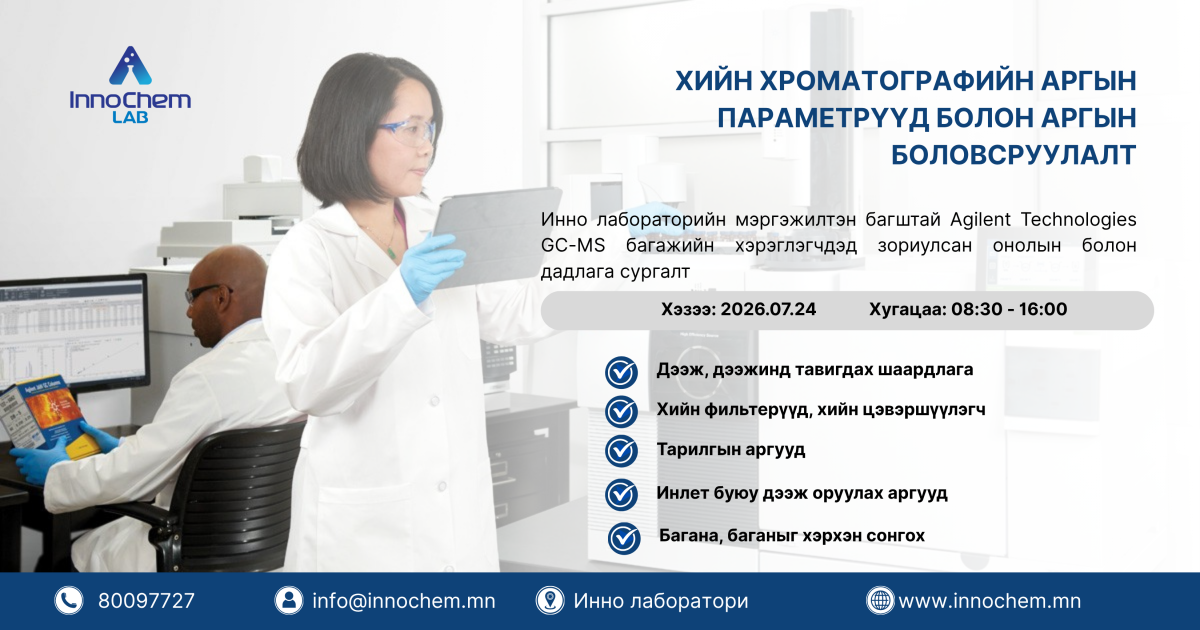
Registration Now Open: GC-MS Method Parameters and Method Development Training Seminar
Gas Chromatography–Mass Spectrometry (GC-MS) is one of the most widely used analytical techniques in modern laboratories for the determination of organic contaminants, pesticide residues, volatile and semi-volatile organic compounds (VOC/SVOC), polycyclic aromatic hydrocarbons (PAHs), polychlorinated biphenyls (PCBs), pharmaceutical residues, and many other trace-level compounds.
Obtaining reliable analytical results depends not only on the performance of the instrument but also on proper method development, parameter optimization, sample preparation, and quality control. This training is designed to provide participants with practical knowledge and technical skills for developing and optimizing GC-MS analytical methods.
As part of its commitment to advancing analytical laboratory capabilities in Mongolia, Inno Chem Lab LLC, through Inno Laboratory and the Agilent Demo Center, has been continuously organizing professional training programs on GC, GC-MS, HPLC, ICP-OES, and other advanced analytical technologies. To date, more than 500 laboratory analysts, researchers, engineers, and technical professionals have successfully participated in our training programs.
Seminar Highlights
- Combination of theoretical lectures and hands-on laboratory practice
- Delivered by Senior Specialists and GC-MS Application Engineers from Inno Laboratory
- GC-MS method parameter optimization
- Fundamentals of method development, optimization, and validation
- Practical demonstrations using real samples
- Data processing, interpretation, and troubleshooting techniques
Who Should Attend?
- Food testing laboratory professionals
- Environmental laboratory analysts
- Pharmaceutical laboratory specialists
- Mining and geological laboratory personnel
- University researchers and academic staff
- GC-MS users and laboratory professionals planning to implement GC-MS technology
Registration Fee
- FREE for organizations using Agilent Technologies GC-MS systems
- MNT 200,000 for users of other GC-MS brands and students
Registration
Training Date: 20 May 2026
Register Here
👉 [Insert Registration Link Here]
For further information, please contact:
Phone: +976 8009-7727
Participants will receive a confirmation email containing the venue, detailed program, and additional information once their registration has been successfully completed.